

At Deliverome Bio, we’re mapping surface protein abundance and internalization to find new handles for targeted delivery. As we started setting up our first functional genomics and mass spectrometry experiments, we asked a seemingly basic question: which human proteins are actually accessible on the surface, where an antibody or other therapeutic can reach them? It turns out that it’s not very clear.
Only about 10–20% of the human proteome is on the cell surface, but over 65% of approved drugs target these proteins, since they can be reached without first crossing the cell membrane. Many databases have tried to catalog them — UniProt, GO CC, the HPA, the CSPA, and SURFY, among others. When we looked at the overlap between them, we found that each database held thousands of proteins, but all five agreed on only 188 proteins (less than 10% of the average database’s size).
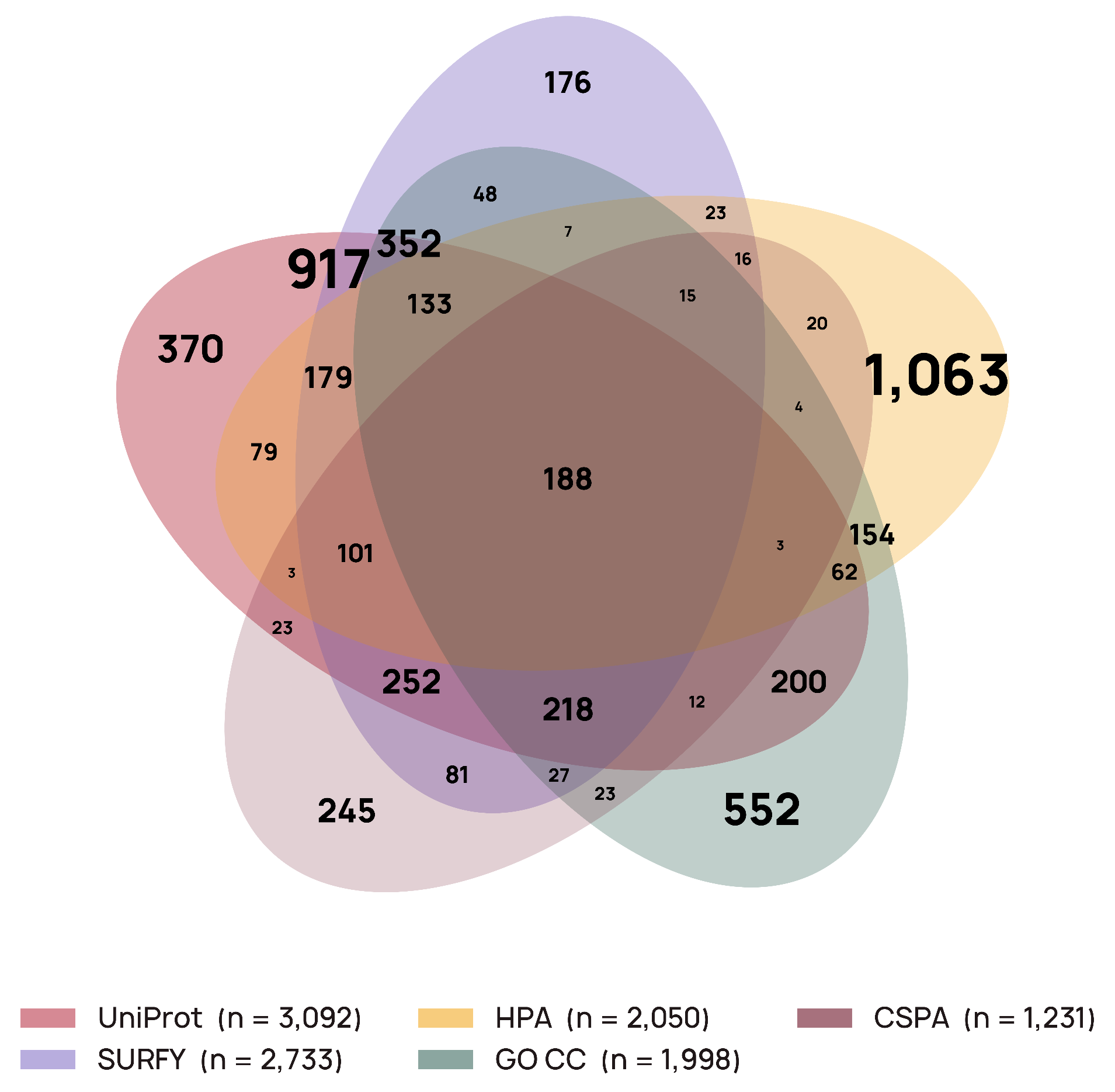
That disagreement isn’t only about quality. Each database was built via different methods for somewhat distinct purposes and therefore defines “surface protein” accordingly. The HPA, for example, detects proteins on either side of the outer membrane and counts both as surface, so an inner-leaflet protein qualifies even though an antibody or gene therapy can’t reach it. The CSPA only measures proteins on the outside that are glycosylated, a common but not required feature for a protein to be on the surface. SURFY predicts surface localization based on sequence, while UniProt and GO rely on curation from the literature.
There’s also a harder problem beyond this: whether a protein is on the surface or not often isn’t fixed. It depends on cell type, cell state, stress, or more. That kind of information often lives in the text of a paper, but if the protein makes it into the database, that nuance is usually lost, making it hard for researchers to interpret a surface protein’s inclusion.
This is the kind of problem that LLMs are good at, so we wanted to see how far we could get with them.
Agents read the literature better than we expected
We built a benchmark first to see how LLMs performed at tricky surface protein calls. SurfaceBench is a set of 147 proteins deliberately enriched for cases where the five databases disagree, each one manually labeled as surface, contextually surface (for example, cell-state- or cell-type-dependent), or non-surface. We then prompted a triage agent to make the same call, returning a verdict, a short rationale, and a reason code from a fixed 19-category taxonomy.
On this deliberately hard set, Claude Sonnet 4.6 with no external tools classified proteins more accurately than any of the five databases. Supplying a small block of additional context (the protein’s summary, identifiers, and HGNC name) helped modestly; adding a web or PubMed search tool didn’t meaningfully help and cost more, but it did improve some specific calls.
Since we didn’t want to lose real surface proteins at this stage, we gave a second triage agent PubMed access and had it re-check the negative calls that the databases didn’t already settle (n = 14,404). Run across the whole proteome, these agents rescued 1,108 candidate surface proteins that were absent from all five databases, including credible therapeutic targets like HSP70 and ASPH. As expected, the proteins the agents found but the databases missed tend to lack classical surface protein signatures such as a transmembrane helix, GPI anchor, or glycosylation sites. These non-canonical proteins can often be especially interesting for therapeutic targeting due to their absence from the surface on normal tissues, which can provide a precision delivery handle for a disease-specific state like cancer.
A verdict isn’t enough
For example, KLK2 is a serine protease made by prostate cells, and it was long thought to be secreted and therefore not a candidate for surface-targeted therapeutics. But researchers later found a membrane-bound form enriched in prostate cancer, which is now the target of a J&J therapy in Phase 3 trials. All five databases, and our triage agent without PubMed, call KLK2 non-surface. With PubMed, the agent correctly calls it contextual. But “contextual” on its own doesn’t tell a scientist much.
So we built a “deep dive” pipeline that reads the literature for each candidate and returns a structured record: a set of graded, queryable attributes, each traceable back to a direct quote from the paper it came from, layered on top of deterministic features we computed ourselves (topology, extracellular domain length, AlphaFold structural predictions, orthologs, paralogs, and published predicted antibody binding sites). We ran this on over 5,000 candidates: everything in an existing database or called surface by our triage agent, minus proteins that appeared in only one database and that triage confidently called non-surface.
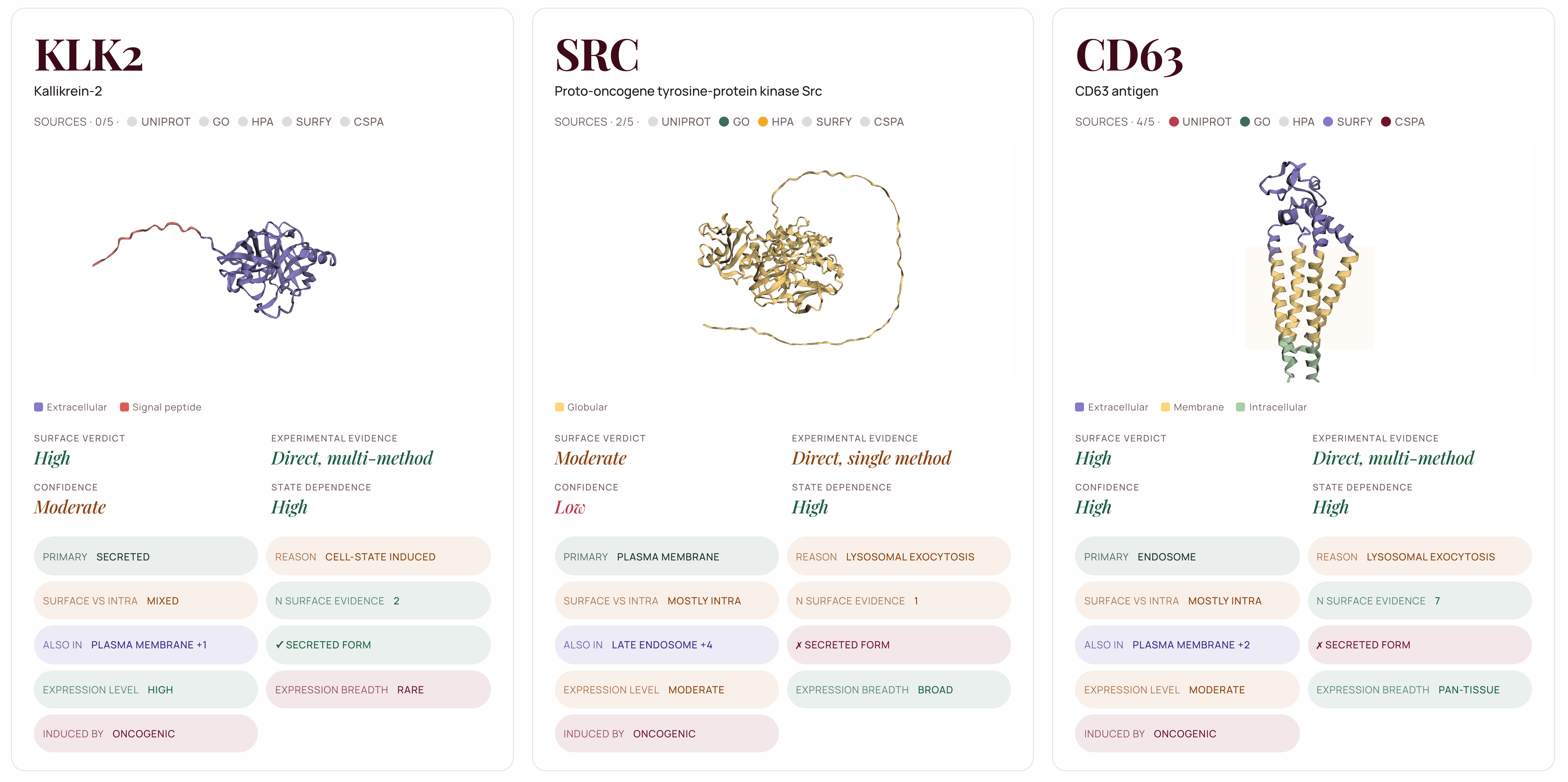
This gives us nuance that a scientist can actually filter on, as well as rationale and citations for a deeper dive. A few examples:
KLK2 becomes annotated as cell-state-induced in cancer. Additionally, its secreted form is clearly called out.
SRC normally sits on the inner face of the membrane, but a report from this January showed it can flip to the outer surface in disease contexts like cancer. Two databases (GO and HPA) already call it surface, likely on the basis of its inner-membrane localization, which large molecules can’t reach. Our agent also returns SRC as surface, but tags it as high state-dependence (disease-induced), resting on direct but single-method evidence, with a mechanism (lysosomal exocytosis). If you’re hunting for induced surface events as targets, you can mine for cases like this; if you’re not, you can filter them out.
CD63 reaches the surface in a state-dependent way (on mast cell degranulation) and is called surface by 4 of 5 databases. Our tags flag its primary localization as endosomal, which makes it weaker as a standalone surface target but potentially attractive for multitargeting degrader approaches.
The gasdermin family of proteins (GSDMs), including GSDMD, are normally cytosolic, but perforate the plasma membrane during innate immune responses. The models correctly flag their primary cytosolic localization and contextualize their state-dependency during inflammation.
Across the cohort this deep dive pipeline gave us 1,783 “canonical” and 1,252 likely surface proteins, with cell-state induction and cell-type restriction as separate facets rather than caveats buried in hard-to-search text. Since we included >30 total filterable attributes as well as free-text rationale to facilitate reanalysis, you can rebuild the database at whatever evidence bar and context definition you need — restrict to direct multi-method evidence, to a particular experimental method such as live-cell flow cytometry, or to state-independent presentation — instead of inheriting our definition.
From results to an open database
A dataset this size is only useful if you can explore it, so we built an open viewer that shows the agent’s reasoning alongside the deterministic data. Everything is browsable at surfaceome.deliverome.org, with a public API for high-throughput querying, and the code is open so the viewer itself is reproducible and adaptable. Spot a mistake on your favorite protein? You can leave feedback, and even make it public so the next reader sees it if you’d like to.
The open-access ceiling
When we audited the papers our pipeline retrieved for a random sample of 100 candidate surface proteins, almost all of the full text our agents could read came from PubMed Central. When we cast a wider net across the literature, about half of the papers we found had no copy an agent could reach. bioRxiv, the largest preprint server in biology, releases full text only as monthly bulk drops on a requester-pays S3 bucket, so an agent fetching one paper at a time can’t read a bioRxiv preprint at all. Thanks to NIH’s Preprint Pilot program, PubMed Central now includes NIH-funded preprints from 2023 onward, but not other preprints. An LLM-curated database like ours therefore reflects not the state of the science overall but the smaller segment of open-access articles that agents are also permitted to read. For this paper, we deposited the PDF and a structured XML version on Zenodo under its bioRxiv DOI, so agents can read it too.
And beyond the open-access issue: no curation method, however good, can describe a measurement that no one has made, or text that incorrectly interprets the outcome of an experiment.
What’s next
This database captures whether a protein reaches the surface and in what context, but it says relatively little about how much is there or how quickly it internalizes to bring cargo into the cell. Those are the fit-for-purpose measurements we’re generating at Deliverome, and we plan to fold them into future versions of the viewer and release them as machine-readable and open source, so others can analyze them with their own agents.
The approach we used to create this surface database is really just one instance of a more general approach: lightly triage the proteome, deep-dive the candidates with an agentic pipeline, and emit structured, citable attributes. Because these databases are configurable, grounded in quotes from the literature, and updateable as new findings arise, we think the same approach can build many more biological knowledge bases across different scientific domains.
The full paper is on bioRxiv and on our website. Analysis and viewer code are on GitHub.